

Making music doesn't always follow a linear sequence
Compartmentalizing your creative process for more creativity.

Quick note before we begin:
Most of my writing here has been longer, in-depth essays. I’m starting to mix in shorter pieces like these Studio Notes. More focused, easier to apply ideas you can implement immediately. Hope you enjoy…
There’s an unspoken assumption most producers carry into the studio:
That a good session ends with something finished.
A loop, sketch, or at least a rough song idea with a name and a core concept. Proof you can look back on which tells you it was time well spent.
But what if that doesn’t happen?
What about when you spend two hours digging through samples samples, presets, or building out a chord progression which you just can’t make work.
It can feel like the session didn’t count.
Like you were busy but not productive.
Like you were circling the work without actually doing it.
But for me, framing it this way caused more harm than good, and when working with other artists I also realized it was a common experience.
Because the reality is music production isn’t a single activity, it’s a collection of distinct skills and actions that each require their own kind of attention.
sound design
arrangement
harmony
texture
structure
curation
Most artists try to do all of them at once, inside of one session, and then wonder why the process feels slow, scattered and overwhelming…
What I’ve realized over the years is that some of the most valuable work you can do in the studio has nothing to do with finishing a song. It’s actually about working on the individual pieces that will make finishing easier later.
The preparation for the work.
Building a couple of arrangement templates means the next time you open a session the scaffolding is already there, just choose one and use it as a guide.
Curating a sample folder means you’re not breaking creative flow to search for the right sound, it’s been pre-selected by you.
Dedicating a full session to simply writing chord progressions means you have raw material ready starting points when inspiration arrives.
These examples aren’t detours from the creative process, they’re part of it.
It helps to like a disciplined “meal prepper” for a second.
On Sunday night, you gather all of your ingredients to cook for the week. You don’t start by slicing up your carrots for each individual serving of the week, you slice all the carrots you will need for all of the servings that week.
Now think on how you can apply this concept to your own creative process.
Some sessions are for building, some for gathering and others are for organizing the tools. That way, when the moment to cook comes, the ingredients for the song idea area already there, prepped, ready and there’s nothing that gets in the way.
The linear model of music-making does work but it’s too limiting…
Open session → find sounds → write chords → arrange → mix → done.
Because it assumes you always arrive at the studio with the same kind of energy, the same kind of focus, the same creative appetite.
However, you don’t.
Nobody does, because every day is different. We’re humans and our biology, experiences and moods are constantly in flux.
Matching the type of session to the kind of energy you actually have is a more honest way to work, and more gentle on your mental health.
So what does this look like for you in practice?
Keep a running list of different kinds of studio sessions you can do on different days.
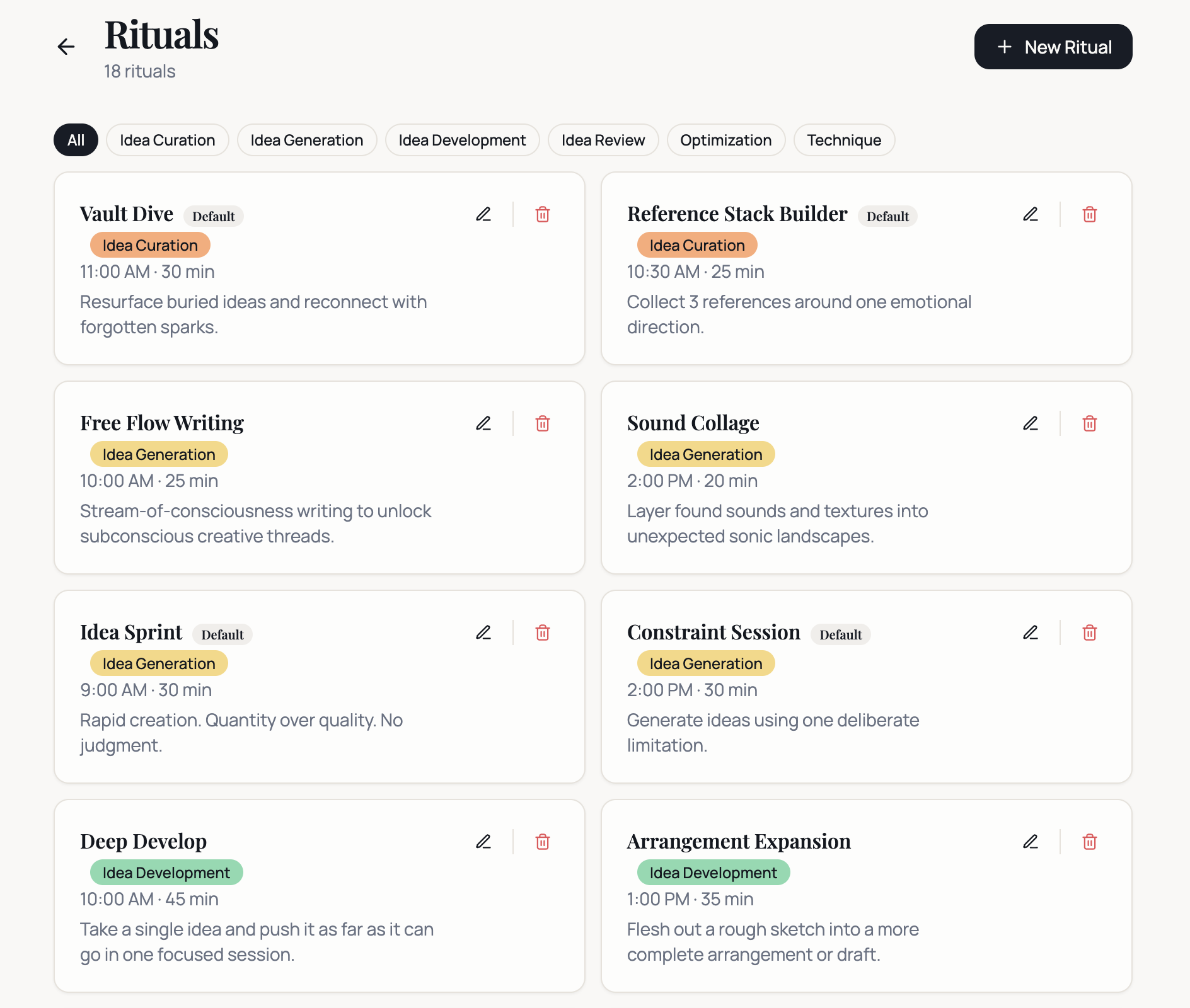
Execute them in compartmentalized batches.
Monday = Curate preset and sample folders.
Tuesday = Compose only chord progressions.
Wednesday = Create arrangement templates based on your references…
Get creative with it, remember this is for you.
This is exactly how my creative yield stays consistent even when the inspiration doesn’t.
— Hermes
P.S. Most artists keep everything inside one project file, and curation, sketching, arranging all blur together. That’s usually where the friction and overwhelm comes from.
I’ve been building something around this idea with Song Ritual where each type of session has its own space, and you can move between them depending on the energy you have that day.
Song Ritual is currently in public beta and can be accessed at a discounted price (when you sub, you lock the price in for life just for being early).
If you’ve been meaning to finish more music this 2026 you can explore how Song Ritual can help you do that here.