

The Musical Creative Process (The Framework Behind Everything You Create)
The Musical Creative Process, revisited & why it's the foundation of my creative philosophy and everything you create.

I published my first Substack newsletter as Hermes on February 3, 2024.
This was almost a year after I created the Sound + Creativity Instagram account at 0 followers around June of 2023.
At first I just shared clips of prolific and iconic artists sharing nuggets of wisdom about the creative process like the one below:
(This clip is from Lex Fridman Podcast #275)
My daily life consisted of searching, listening, mining, and cutting clips to share. However, the most important thing that happened during those months was repeatedly listening in on the conversations, insights and advice of world class creatives.
This is what gave me a crystal clear understanding about how the most prolific artists operated and thought about creativity.
Naturally, I started to notice patterns and recurring themes in what they all shared.
Soon enough this inspired me to start writing about my own process, what I’ve learned and how maybe I could bring more context, depth and build upon to their lessons so other artists can apply it in a practical way.
Slowly my body of work grew and I managed to grow a combined following of over 50k+ and counting followers on all social channels.
But beside the metrics, something deeper within me was taking shape.
A creative philosophy, a framework and comprehensive system which I began to use with success in my own creative process emerged.
Not just based on my own experience but from what I learned working with other artists and from what I had picked up from listening to countless hours of prolific artists speak about their process.
And while I fully agree with the sentiment that everyone’s process is different, my aim was to distill this creative process into universal fundamentals which any artist could apply and adapt in their own way.
Think of it like an open source creative process for music creators.
Fast forward to today...
Every article I’ve written.
Every framework I’ve shared.
Every concept, every exercise, every reflection on what it means to make music consistently and authentically all traces back to this one framework.
And for a long time, I’ve referenced it in my work in many ways. Sometimes I’d zoom into one or two aspects of it, but I feel now is a good time to show you the complete picture once again.
Consider this a reintroduction, a homecoming.
If you’re new here, consider this your orientation to my creative philosophy.
But before I share this framework I want show you why and how it came about. So let’s go back in time to the year 2020.
Creativity Is Not A Gift, It’s A Way Of Operating
For years, I thought my lack of creativity was a talent problem.
“Some people are just born with an innate talent and creative ability”, or so I thought.
I’d sit down to make music and feel that familiar weight of the blank session staring back at me, the cursor blinking, the options multiplying until they paralyzed me.
I’d open a plugin, close it.
Start a loop, abandon it.
Spend two hours tweaking a snare or perfecting a preset and call it a session.
I told myself I just wasn’t disciplined enough, that I needed more time. Then these recurring experiences haunted me and made me believe that maybe I wasn’t cut out for this music making thing.
And it took me an embarrassingly long time to realize the truth that it wasn’t a talent problem, a time problem, or even a discipline problem.
It was a clarity problem.
I didn’t understand my own creative process.
I was trying to navigate somewhere new with no map, no GPS, no one to ask for directions. And without a map, you can’t have a strategy or at the very least go in the best general direction.
Without a strategy, every session becomes a gamble.
Sometimes you win, but more often than not you wander and burn away the available time you had for making music.
The moment I started understanding how I actually created, and broke down the real sequence of events that needed to happen that’s when everything changed. It didn’t happen overnight, but steadily, session after session I began to make music with more intention.
But most importantly I started finishing more songs.
I started feeling less dread before sessions.
I started recognizing where I was getting stuck and why.
And slowly, I began to build a catalog of songs I was actually proud of, that felt completely authentic to me.
This framework became the spine of everything I’ve written here, I call it:
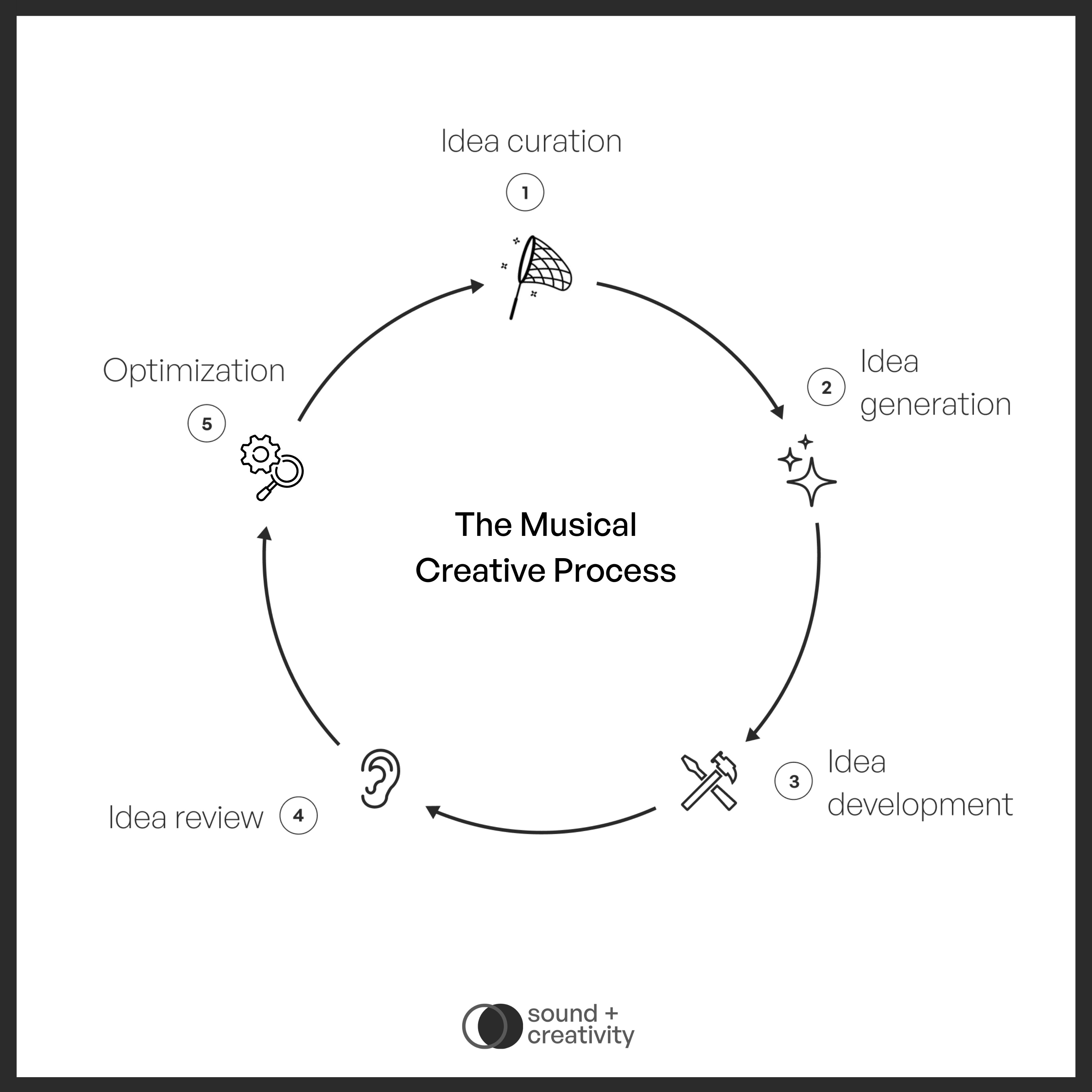
The Musical Creative Process.
What Is The Musical Creative Process (And What It Isn’t)
Before I walk you through it, I want to be clear about what this is.
The Musical Creative Process is not a productivity hack.
It’s not a rigid system you follow like a recipe.
It’s not about squeezing more output from fewer hours.
(Although it can help you with all of the above, that’s not the purpose behind it)
It goes much deeper...
It’s a creative operating system.
A way of understanding the fundamental phases of how music gets made, so you can mold this framework to your liking and preferences.
Here’s the definition I keep coming back to:
The Musical Creative Process
The sequence of steps and phases that music creators undertake to generate, refine, and complete a musical idea.
Simple on the surface, but the implications run deep. And here’s what most producers don’t realize:
You’re already moving through these stages every time you create.
The question isn’t whether you have a process, you do! The question is whether you’re doing it consciously or unconsciously.
Whether you’re navigating with a map or stumbling in the dark.
Awareness and clarity are your greatest weapons against creative procrastination. This framework is how you can get both.
The 5 Stages Of The Musical Creative Process
Now I want to walk you through each stage not as a checklist, but as a moment in the creative journey. Because that’s what they are:
Moments, states of mind and modes of being.
By the end of this article you should be able to identify each one in your music making process and have a better understanding of it as a result.
Stage 1: Idea Curation — Collecting Ideas
Picture this, you sit down to create a new song and you have nothing. No spark, no direction, just the blank canvas and the weight of infinite possibilities.
This is what I used to call Blank Canvas Syndrome.
And for a long time I thought it meant I wasn’t inspired. I thought I needed to wait for something to arrive.
What I didn’t understand was that inspiration doesn’t ONLY arrive, it can also be collected and engineered (to a degree).
Idea Curation is the stage where you seek, select, and save potential musical concepts and sources of inspiration throughout your day to day life or within dedicated sessions.
It’s about building what I call your Inspiration Vault.
Inspiration Vault
A living, breathing collection of reference points, sonic ideas, lyric hooks, voice notes, and emotional textures that you can draw from when you sit down to create.
So in reality the blank canvas can be completely avoided if you’ve already collected ideas to fill the digital canvas (your DAW).
That’s one less step you have to worry about when sitting down to create, therefore increasing your chances of taking your next song further into the process, and closer to finishing.
But here’s the catch:
Curation isn’t passive, it’s one of the most active, intentional things you can do as a music creator. It’s the raw input that will shape the music you make.
What it feels like when you’re doing it right:
You’re a collector, a researcher and you’re listening with purpose, saving ideas with intention, building a reservoir that will feed your creative sessions.
Where most artists go wrong:
They skip this stage entirely and wonder why they always feel uninspired. Or they curate endlessly and never move to the next stage using the “research” as the building blocks to actually start creating a new song idea.
Stage 2: Idea Generation — The Initial Spark
After you’ve collected ideas it’s time to finally create a new song.
This is the stage I used to call “unfiltered musical idea vomit”, and I stand by that description, because it captures something important. The goal here is not quality, the goal is volume.
You’re just shoveling sand into the playground.
You’re getting every idea out of your head and into your DAW, regardless of whether it’s good or bad. Remember that the inner critic has no place in this room.
No filtering.
No second-guessing.
Just unrestrained output.
This is because what I’ve discovered is that the path to quality occurs not in spite of quantity, but because of it.
You can always cut or modify ideas but you can’t get back the time you could have spent creating new ideas.
Ira Glass said it better than I ever could:
“Your taste is killer, but your skills need time to catch up.”
Idea Generation is where you give these skills the reps they need.
What it feels like when you’re doing it right:
You’re in flow, time disappears and ideas come faster than you can capture them. You’re not thinking about whether it’s good, you’re just focused on recording them and catching them.
Where most artists go wrong:
They bring the critic into the room too early.
They generate one idea, judge it, delete it, and start over. The session becomes a loop of creation and destruction that produces nothing. Or they stay in generation mode forever, always sketching, never developing the idea.
Stage 3: Idea Development — The Shaping Of A Song
Now that you’ve shoveled sand into your playground, it’s time to build the castles.
Idea Development is where raw sketches become real songs.
This is where loops become full arrangements, emotional arcs of a piece starts to take shape and the stage that separates producers who have hard drives full of unfinished songs from producers who have released albums.
It’s also the stage that requires the most courage.
Developing an idea means making decisions, committing to a specific direction, getting detailed with sound design, fleshing out arrangements, eliminating the ideas that aren’t serving the song, especially if they’re the ideas you love.
What it feels like when you’re doing it right:
The song starts to take a personality, a vibe, a mood and a clear intention. You can feel where it wants to go and you’re making decisions with conviction, not anxiety. The arrangement serves the sounds and ideas, and vice-versa.
Where most artists go wrong:
They get attached to the loop and can’t let it evolve, or they develop endlessly by adding, layering, rearranging without ever arriving at a finished piece.
Development without a destination is just a more sophisticated form of procrastination.
Stage 4: Idea Review — The Honest Reflection
This is the stage most artists avoid, or simply don’t make it to.
After pouring yourself into something, the last thing you want to do is sit back and hear it clearly to criticize it. This is because being critical of it means confronting the gap between what you imagined and what you actually made.
The key here is to reframe it:
It’s not a failure if it doesn’t match your expectations, it’s feedback on where you lack and where there’s room for improvement.
Idea Review is the stage where you evaluate and polish your work. It’s where you listen with fresh ears, seek honest feedback, and make the refinements that transform a good idea into a great one.
It’s where you develop what I’d call Creative Courage:
The willingness to revisit and cut what isn’t working, even when you thought it was finished.
What it feels like when you’re doing it right:
You can hear the song as a listener, not just as its creator. You can clearly hear what to keep and what to cut. The feedback you receive lands as useful information, not personal attack on your creative or technical ability.
Where most artists go wrong:
They skip it entirely and release work that isn’t ready.
They get stuck in it, reviewing, tweaking, reviewing again. They use perfectionism as a shield against the vulnerability of releasing.
Stage 5: Optimization — Becoming Prolific
This is the stage nobody talks about, in my opinion it might be the most important one.
Optimization is the continuous process of improving your habits, workflows, and environment so that the other four stages can happen more easily, more consistently, and with less friction.
For example, this can be:
Creating project templates so you’re not starting from zero every session.
Organizing your sample library so you can find what you need when you’re in flow.
Learning your DAW shortcuts so the tool gets out of the way of the idea.
It’s building the rituals, the time blocks, the pre-session routines.
Creating the environmental cues that signal to your brain “it’s time to create”.
Systemizing your process is not always about the tools and software you use, sometimes it’s simply about understanding your process on a more intimate level and then building a daily schedule that is compatible with it.
What it feels like when you’re doing it right:
Sessions start with no resistance and you begin to spend less time setting up and more time creating.
The creative habit feels sustainable, and you’re not solely relying on motivation and inspiration because you’ve built a system that works even when they don’t show up.
Where most artists go wrong:
They optimize obsessively and never actually create. They spend more time building the perfect template than making music.
Remember that optimization is meant to serve the process not replace it.
The Stages Are Not a Straight Line, They’re Fluid
This Musical Creative Process is not meant to box you in or limit you, it’s actually fluid and adaptable to your way of operating.
You don’t always move neatly from Stage 1 to Stage 5 and arrive at a finished song (although you can).
What’s most common is that you revisit, and you’ll find yourself deep in development and realize you need to go back to curation.
You might be in review and discover a new idea that sends you back to generation.
The process has its own rhythm, it’s your job to find which way works best for you.
What matters is that you know where you are at any given moment, because each stage requires a different state of mind, a different mode of being.
The generative mind and the critical mind cannot occupy the same room at the same time.
The developmental mind needs commitment; the review mind needs detachment.
Shifting between these modes without awareness is like trying to drive in two gears at once. It creates friction, confusion, and the particular kind of creative exhaustion that makes you want to close the laptop and watch TV or scroll instead.
Knowing the map doesn’t mean the journey is always smooth, but at least it allows you to never truly be lost.
Why Awareness Matters More Than Ever
We live in a time of infinite tools and infinite distraction.
There are more plugins, more tutorials, more sample packs, more courses than any producer could consume in a lifetime, and yet more producers than ever feel stuck.
More unfinished projects.
More creative blocks.
More comparison, more doubt, more sessions that end with nothing to show for.
So it’s clear that the problem isn’t access to resources, the problem is the same one I had years ago:
A lack of clarity about the process itself.
In my biased opinion having an understanding of The Musical Creative Process is the antidote.
Not because it makes creativity effortless (it will take work). But because it gives you a deeper sense of awareness and understanding.
A way to orient yourself when you feel lost, a language for understanding what’s happening and what to do next with that song you can’t seem to finish.
Structure creates freedom, repetition builds identity, the ritual is the art.
As always, thank you for reading and for the support throughout the years.
— Hermes
P.S. For those who want to apply what you read practically (keep reading)…
After reading this you can probably identify where you get stuck.
Maybe you generate endlessly but never develop.
Maybe you curate obsessively but rarely sit down to build.
Maybe review feels like self-sabotage instead of refinement.
Knowing the 5 stages is helpful, but actually designing your workflow around them is the most transformational.
So today I want to introduce something that I’ve been quietly building behind the scenes.
It’s called Song Ritual.
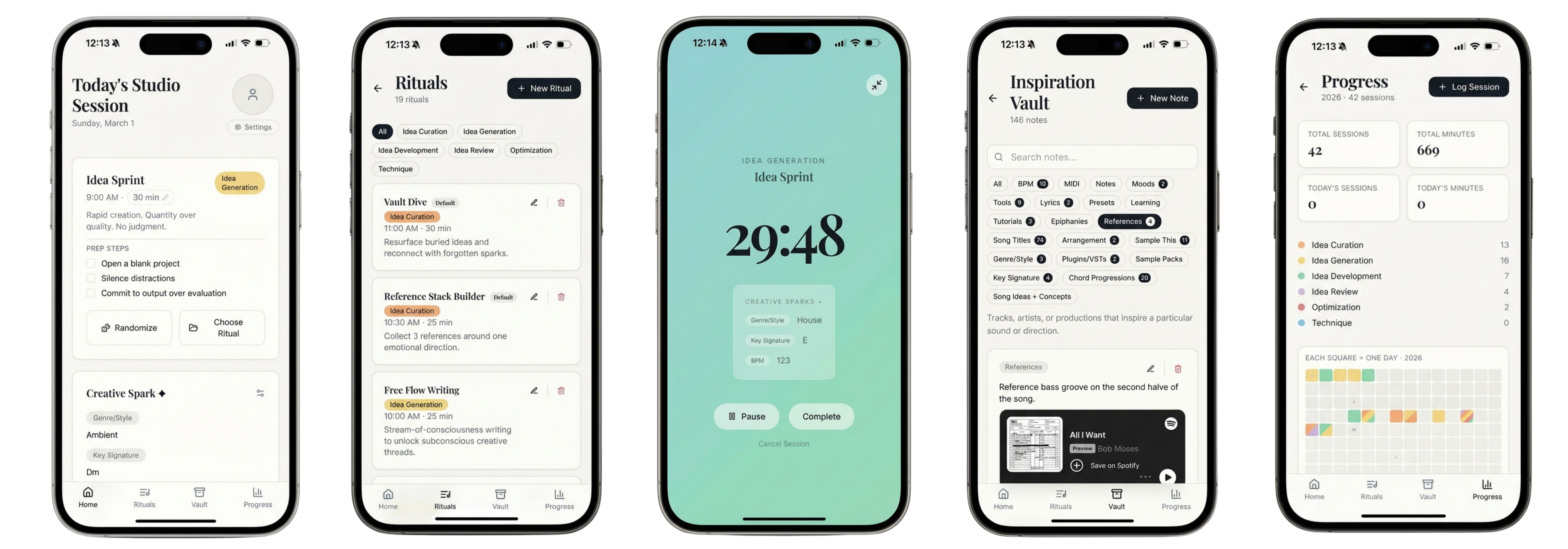
Song Ritual is the music creator’s operating system. It’s a song idea note taking app and creative session timer built directly on the five stages you just read.
It’s a digital workspace for music creators where you can curate song ideas intentionally, generate them with less friction, develop with direction, review with clarity, and optimize without overthinking.
It turns your Inspiration Vault into structured sessions. It separates generation from critique. It creates time-bound rituals so development actually leads somewhere.
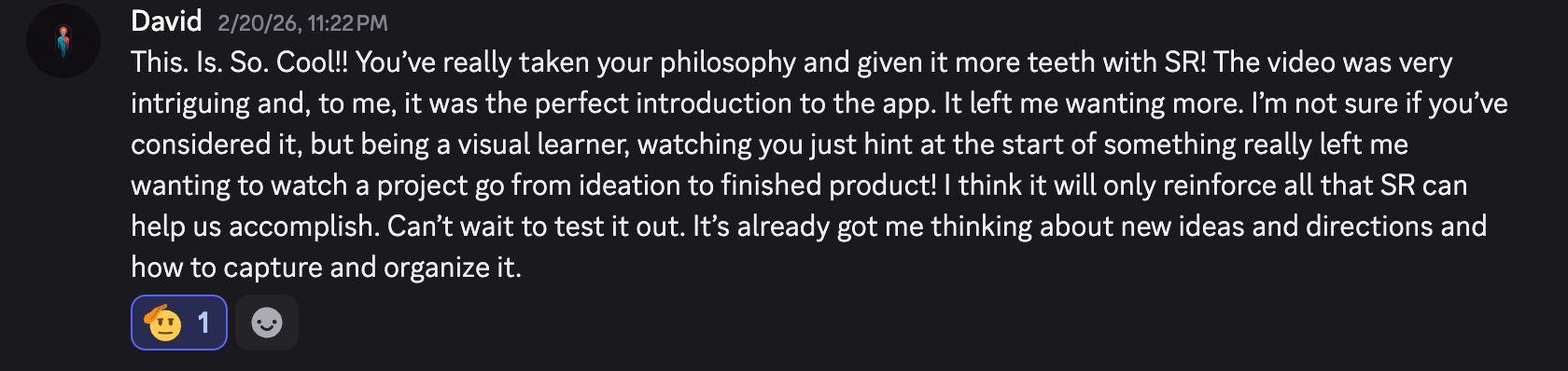
Below you’ll see a few screenshots from inside the app, along with feedback from the current beta group testers (this isn’t just a conceptual idea, it’s a fully functioning app with real users!)






This is not a DAW, and it’s not another productivity app.
It’s a structured environment in your pocket designed to help you move through your own creative process consciously.
If you’ve ever felt stuck between inspiration and completion, this is the bridge.
A clearer environment to move through your own process consciously.
If this framework felt like it put language to something you’ve been experiencing for years, Song Ritual is simply the applied version of that language into a beautiful web app experience.
You can now join the waitlist for the Song Ritual app and get early access when it’s time to enroll the next wave of producers.
If you’re in, learn more here.
See you on the next one.
where to find the app?
This is wonderful, I could already see where I get stuck in the creative loop. I would love to test your app and provide my experience and breakthroughs.